

What is a G-Mark?
The G-Mark, or Gulf Conformity Mark is certificate of conformity that indicates that a product has been tested and certified to meet the quality and safety standards set by the Gulf Cooperation Council (GCC) member states. It is required for a wide range of products that are sold in GCC member states, including Bahrain, Kuwait, Oman, Qatar, Saudi Arabia, and the United Arab Emirates (UAE). Obtaining G-Mark certification is a rigorous process that involves testing and inspections to ensure that a product meets the necessary standards. This includes testing for things like electrical safety, mechanical safety, and environmental performance. The G-Mark certification is valid for 3 years and then the manufacturer or distributor needs to reapply for recertification to maintain the certification.
Why Gulf Mark (G Mark) Certification is Important?
As the GCC member states continue to grow and develop, so does the demand for high-quality products. To ensure that these products meet the necessary standards, the GCC has implemented the Gulf Mark certification program.
The Gulf Mark is a quality mark that indicates that a product has been tested and certified to meet the GCC standards. This mark is recognized by all GCC member states, making it easier for manufacturers and distributors to sell their products throughout the region.
Obtaining Gulf Mark certification is a rigorous process that involves testing and inspections to ensure that a product meets the necessary standards. This includes testing for things like electrical safety, mechanical safety, and environmental performance.
G-Mark Certification Process Explained
The G-Mark, also known as the Gulf Conformity Mark, is a certification mark that indicates that a product has been tested and certified to meet the safety standards set as a part of establishing gulf technical regulations. To obtain the G-Mark, manufacturers and distributors must go through the following process:
Identify the appropriate GCC standard for their product:
The GCC has established standards for a wide range of products, including electrical and electronic devices, machinery, and building materials. Manufacturers and distributors must identify the standard that applies to their products.
Test the product:
The product must be tested by a GCC-accredited testing laboratory to ensure that it meets the relevant standards. The testing process will vary depending on the product and the standard that applies.
Submit the test results:
The manufacturer or distributor must submit the test results to the GCC-approved certification body. The certification body will review the results to ensure that they meet the requirements of the standard.
Obtain the G-Mark Certificate:
If the product meets the requirements of the standard, the certification body will issue the G-Mark. The manufacturer or distributor can then use the G-Mark on their product and packaging to indicate that it has been certified.
Recertification:
The G-Mark certification is valid for 3 years and then the manufacturer or distributor needs to reapply for recertification to maintain the certification.
It’s important to note that, the above process may vary from country to country as the GCC countries have their own regulations and certifying bodies. Therefore, it’s recommended to check with the local authorities for the specific mandatory requirement and certifying bodies for the certificates.
What kind of products requires G Mark certification?
The G-Mark, or Gulf Conformity Mark, is a certification mark that indicates that a product has been tested and certified to meet the requirements and safety standards set by the GCC. It’s required for a wide range of products that are sold in GCC member states, such as:
Electrical and electronic devices:
This includes things like appliances, lighting fixtures, and power tools. The GCC has established standards for electrical safety, electromagnetic compatibility, and energy efficiency for these types of products.
Machinery:
This includes everything from industrial equipment to construction machinery. The GCC has established standards for things like safety, noise levels, and emissions for these types of products.
Building materials:
Building materials products such as cement, steel, and glass also need G-Mark certification. The GCC has established standards for things like strength, durability, and fire resistance for these types of products.
Food and Medical Devices:
The GCC has established standards for food safety, packaging and labelling, and medical device safety, performance, and labelling.
Automotive:
Automotive products must comply with GCC’s established standards for automobile safety, emission, and performance.
Which of the low voltage electrical equipment require G-Mark Certifications?
The Gulf Conformity Mark, or G-Mark, is a certification used in the GCC countries to indicate that a product complies with the Gulf Standardization Organization (GSO) Technical Regulation for Low Voltage Electrical Equipment and Appliances (LVE). Products that require the G-Mark for LVE include, but are not limited to;
- Electric kettles
- Toasters
- Irons
- Hair dryers
- Electric shavers
- Electric fans
- Electric heaters
- Electric cookers and ovens
- Microwave ovens
- Refrigerators and freezers
- Air conditioners
- Washing machines and dryers
- Vacuum cleaners
- Power tools (such as drills, saws, etc.)
- Lighting fixtures (such as lamps, lightbulbs, etc.)
- Electrical components (such as sockets, switches, etc.)
- Electric motors
- Transformers
- industrial products
- Battery chargers
- Children’s toys
- Electric power generators
This list is not exhaustive, and there may be other types of Low Voltage Electrical Equipment and Appliances that require G-Mark. The GSO Technical Regulation on Low Voltage Electrical Equipment and Appliances specifies the safety and performance standards for these products and manufacturers must have their products tested and certified by a GSO-accredited testing laboratory in order to obtain the G-Mark.
Here’s a closer look at the types of regulated children’s toy products:
Regulated Children’s Toy Products:
Toys for children under 14 years of age: This broad category encompasses all toys designed for young users up to 14 years old.
* Functional Toy: Toys that simulate real-life devices or appliances, providing a learning experience while playing.
* Aquatic Toy: Toys designed for water use, ensuring safety and durability in aquatic environments.
* Activity Toy: Toys that promote physical activity, encouraging children to engage in exercise and outdoor play.
* Chemical Toy: Toys involving chemical reactions, like science kits, which must meet stringent safety standards.
* Cosmetic Kit: Kits that allow children to engage in makeup or beauty activities safely.
* Gustative Game: Games that involve tasting or smelling, ensuring they are safe for children’s use.
Olfactory Board Game: Board games designed to stimulate the sense of smell, ensuring non-toxic and safe materials.
Ensuring that toys have the G-Mark certification not only guarantees compliance with GCC regulations but also provides peace of mind to parents and caregivers about the safety and quality of the toys their children use.
STEP BY STEP –
HOW TO GET GOTS-CERTIFIED
Join the movement towards sustainable supply chains by getting GOTS certified today!
Certified textile products show your commitment to environmental and social responsibility. The GOTS certification is more than just a label, it is a symbol of trust and transparency in the textile supply chain – from field to finished goods in stores.
Step 1:
Inform yourself about GOTS
Familiarise yourself with our Standard by having a look at our GOTS materials, our latest Standard version, and our Q&A section. This will provide you with an overview of the requirements that must be met for your certification.
Step 2:
Reach out to the GOTS Representative in your region
If you seek initial consultation, you can reach out to one of our GOTS Regional Representatives, listed here. If you require more detailed assistance or guidance on complex issues, please get in touch with a GOTS Approved Consultant.


Step 3:
Choose a GOTS-approved Certification Body
Here you will find a list of independent GOTS-Approved Certification Bodies, responsible for the on-site audit and certification to GOTS.
Step 4:
Contact your GOTS Certification Body
Submit an application to the Certification Body of your choice. The application may require you to provide details about your facility or product, including your location, scope of operations, and the goods you manufacture


Step 5:
Prepare for the on-site audit
The Certification Body will inform you about the implementation and schedule an audit. It is important to prepare all necessary documentation and records for review, about which you will be informed by your Certification Body ahead of time. In case any non-compliances with the Standard are detected, these will be assessed and a timeline for correction will be provided to you.
Step 6:
Receive your GOTS Scope Certificate
Once you receive your GOTS Scope Certificate, you can leverage it to showcase your commitment to sustainable and ethical textile production. Your company will be found in the GOTS public database.

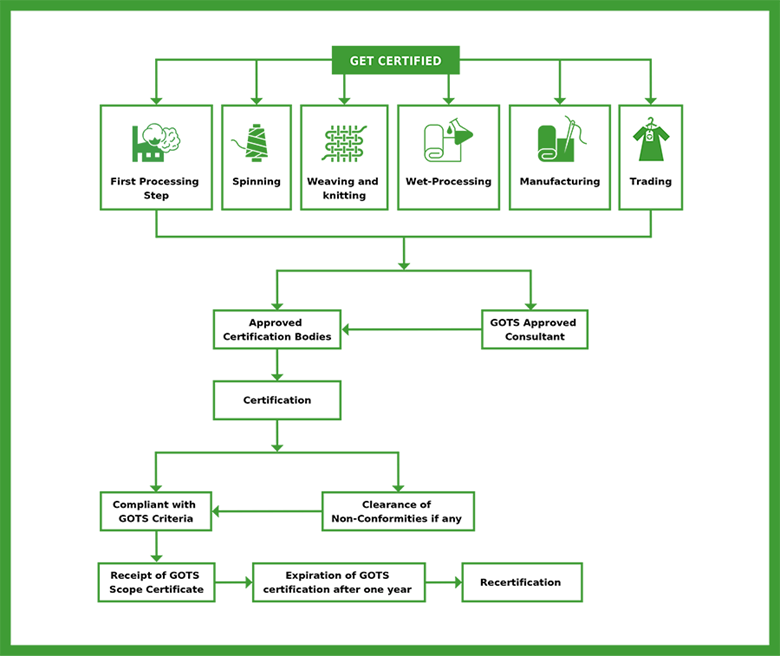
GOTS certification process at a glance
How do you correctly label your certified products?
Anyone who intends to sell, label or represent any textile product with the trademark-registered GOTS logo, with GOTS labelling and/or any other reference to GOTS (certification) must first ensure that they meet the respective criteria and conditions of the Global Organic Textile Standard Programme.
APPROVED CERTIFICATION BODIES
Look for Certification Bodies that are currently approved to Certify entities of the textile supply chain and their products according to GOTS All listed Certification Bodies can offer their GOTS certification services in their approved scopes worldwide. Approval for certification is provided for 4 different scopes by GOTS:
- Certification of mechanical textile processing and manufacturing operations and their products (scope 1)
- Certification of wet processing and finishing operations and their products (scope 2)
- Certification of trading operations and related products (scope 3)
- approval of textile auxiliary agents (chemical input) on positive lists (scopes 4)
Search for the respective scope and contact details of the certification Body and local office representatives that may provide information with regard to GOTS certification are also stated.
Note that not all offices have the services of a locally available GOTS auditor/inspector. Prospective GOTS entities are encouraged to obtain more information by contacting the certifiers.